Screenplay by Carl Foreman and Michael Wilson (originally credited to Pierre Boulle, as both screenplay writers were blacklisted at the time)
Adapted from the novel The Bridge over the River Kwai by Pierre Boulle
During World War II, British POWs are forced to build a Japanese railway from Burma to Singapore. Colonel Nicholson is a proud, rule-following Englishman who has been brought to a prison camp with his men following orders to surrender. After a lengthy battle with the camp's warden, Colonel Saito, about whether officers should be forced to work alongside their men, Nicholson sets out to build the best bridge possible as a demonstration of British skill. Meanwhile, a specialized team of Allied soldiers is sent to blow up the bridge.
This is another relatively short novel adapted into a long movie, but it's significantly better than the previous year's winner. The added length helps the film give a better feel for how much time has passed than the book did. Most of the prison camp scenes are very faithful to the book. Even when details are changed, such as the exact methods of torture Saito uses to try to break Nicholson, those parts are still very much in the spirit of the original story.
On the other hand, the demolition team is completely different, particularly the character of Shears. In the book, he's a British major from Force 316 who is basically in charge of the mission and is often referred to as Number One. In the film, he's from the American navy, and is actually in the prison camp when Nicholson arrives. Movie Shears manages to escape from the camp, after which he reluctantly joins Force 316 to help them find the bridge, after it's revealed that he's been impersonating an officer. So in the book, he's very focused on finding and destroying the bridge, whereas in the movie he's cynical and sarcastic and always trying to find a way out of returning to the prison camp he managed to escape from. This completely changes the dynamic of the team. I think both versions work fine, but I'd be interested to know what prompted this change. Did they just really want William Holden to have a big role in this movie, and he couldn't or wouldn't do a convincing British accent? Who knows? The other characters in the team are also changed, though not as drastically. Joyce is basically the same inexperienced but eager young soldier, although in the film he's Canadian instead of British. Also, the film adds a scene when he's faced with killing a Japanese soldier and can't do it, which takes the place of the part in the book after the river's gone down and he realizes he's probably going to have to kill someone and is trying to psych himself up for it. This additional scene in the film also results in the third team member, Warden, being shot in the foot, which gives him an excuse for remaining farther away from the bridge. In the film, that was just always the plan. Also the film adds a fourth member of the team who dies during the parachute drop, which did not happen in the book.
Perhaps the most significant change, however, is the ending. I feel like most people have probably seen this movie (if you haven't you should), but skip the rest of this paragraph if you don't want any 60-year-old spoilers. Fascinatingly, the climax is almost exactly the same except for one thing. Nicholson leads Saito to Joyce, who was waiting for the train to arrive before blowing up the bridge. Joyce kills Saito, then Nicholson yells for help and starts strangling Joyce. All of that happens in both versions. But the famous moment in the movie when Nicholson looks around, cries, "What have I done?" and then stumbles toward the detonator, and falls dramatically on top of it, demolishing his bridge as he dies? Yeah, that doesn't happen in the book. Warden had put some extra explosives on the track, so the train ends up going down, but the bridge remains intact with minimal damage. Book Nicholson dies without ever experiencing that change of heart. Personally, I prefer the movie version, although the book's is probably more consistent with Nicholson's character. I like to think that he still had some humanity inside that cold, mechanical exterior, even if that wasn't what the author of the book intended.
After the previous winner, I have to mention how refreshing it was to see actual Japanese actors cast in the role of Japanese characters. The book actually seemed more racist than the movie, repeatedly referring to the Japanese as stupid and inept and just generally inferior to Westerners. There is some of this in the movie, but the film version gives more of the impression that they're trying to prove how competent British soldiers were, rather than how incompetent the Japanese soldiers were. One change along these lines that I liked was the film had Saito fire the Japanese engineer on his own, whereas in the book he only did because Nicholson told him to. On the other hand, the book emphasizes that most of the well-qualified Japanese engineers were engaged elsewhere during the war, while the film kind of implies that the clueless guy at the camp was the best they had to offer. So it's a trade-off. Still, Sessue Hayakawa's performance as Saito is one of the highlights of the film, and letting an actor of color shine like that, even in the role of a villain, was extremely rare in 1950s Hollywood, so yay progress.
After this, one of my favorite Best Picture Winners, I have to go back to another of my least favorite Best Picture Winners, Gigi, based on the novella by Colette.
Saturday, November 25, 2017
Friday, November 24, 2017
1956: Around the World in 80 Days
Screenplay by John Farrow, S. J. Perelman, and James Poe
Adapted from the novel Around the World in Eighty Days by Jules Verne
A prim and proper English gentleman named Phileas Fogg makes a wager that he can circumnavigate the globe in exactly 80 days, and immediately sets off with his new valet, Passepartout, to prove it. Unbeknownst to him, Fogg is pursued by a detective named Fix, who is convinced that Fogg robbed the Bank of England and is using this trip as an excuse to flee the country.
This might be the worst adaptation to have won this award so far. Not that the novel is the best book I've ever read, but it is far and away superior to the film. There are so many problems with the movie I hardly know where to start. It completely ruins the character of Passepartout. In the book he's a loyal, well-meaning but slightly clueless Frenchman. The movie turns him into a woman-chaser of ambiguous nationality. I guess he's Spanish, since he speaks Spanish, but sometimes he calls Fogg "Monsieur", so it's like, was he supposed to still be French with a Spanish accent? Speaking of which, the movie adds this whole section where the travelers take a hot air balloon in France, trying to get to Marseilles, but they end up in Spain where they have to waste an entire day fighting bulls. This scene is way too long, entirely unnecessary, somehow doesn't seem to put them behind schedule, and is not even remotely close to anything that happens in the book.
The Spanish detour is probably the most extreme example, but similar unnecessary additions occur throughout the film. Instead of Passepartout merely wandering into an Indian temple with his shoes on, he has to be chased in there after trying to bullfight a sacred cow (what is it with this movie and bullfighting?). Later they enter an American saloon for no reason and stay there way too long. Generally, when novels are adapted into screenplays, more scenes are cut than added. Obviously, some bits were cut in order to make way for these additions, but not nearly as many as necessary, resulting in a 3-hour long film adapted from a novel that's just over 300 pages. Compare that to one of the best adaptations, Gone with the Wind: that novel is over three times as long as this one, but the movie is only one and a third times as long. Not to mention that cutting out those few minor scenes from the book gives the movie possibly the worst pacing ever. The book doesn't have the best pacing, but at least it carefully tracks how long it takes to get to each milestone and how long they stay there and whether they've gained or lost time. In the film, one has no idea how much time is passing, which is odd since the 80-day deadline is crucial to the plot.
Even if it had been a decent adaptation, which I cannot stress enough that it wasn't, it would not have aged well, and not just because it's now laughable to think that it would take anywhere near that long to go around the world. The original book is quite racist, and uses a lot of problematic terms like "savages" to describe the native peoples in the lands the travelers cross. One might think that since the film was made over 80 years after the book was written, they might have found some way to make it less blatantly racist while still remaining faithful to the time in which it takes place. Unfortunately, this was the 1950s, and if anything, the movie is more racist than the book. I mean, the vast majority of the "native peoples" were very clearly white actors in makeup. I get that they wanted to put fun cameos of famous actors around the world, but this doesn't really work when all the famous actors are white. Shirley MacLaine is supposed to be Indian? Peter Lorre is supposed to be Chinese? I know this was 60 years ago, but still. They could have at least gotten actual people of color to play the extras, and I think maybe there were a couple, but for the most part, sadly no. This would be cringe-worthy enough if it was a good movie otherwise, but the fact that it's cringingly racist and a badly-paced, boring mess means I cannot recommend against it enough.
That being said, I feel that in fairness I must point out that this movie does have some of the best ending credits I've ever seen, brilliantly designed by the legendary Saul Bass. So if, you know, you ever end up having to watch it for a self-imposed Oscar project, you at least have that to look forward to. Personally, I'm going to make sure that, if I continue tackling different categories, I never pick another one that this movie won. I've had to watch it twice now; that is more than enough.
Up next: Best Picture Winner The Bridge on the River Kwai, based on the novel The Bridge over the River Kwai by Pierre Boulle. I'm not sure why they changed the preposition, but if that's the most unnecessary change it will be leaps and bounds ahead of this adaptation.
Adapted from the novel Around the World in Eighty Days by Jules Verne
A prim and proper English gentleman named Phileas Fogg makes a wager that he can circumnavigate the globe in exactly 80 days, and immediately sets off with his new valet, Passepartout, to prove it. Unbeknownst to him, Fogg is pursued by a detective named Fix, who is convinced that Fogg robbed the Bank of England and is using this trip as an excuse to flee the country.
This might be the worst adaptation to have won this award so far. Not that the novel is the best book I've ever read, but it is far and away superior to the film. There are so many problems with the movie I hardly know where to start. It completely ruins the character of Passepartout. In the book he's a loyal, well-meaning but slightly clueless Frenchman. The movie turns him into a woman-chaser of ambiguous nationality. I guess he's Spanish, since he speaks Spanish, but sometimes he calls Fogg "Monsieur", so it's like, was he supposed to still be French with a Spanish accent? Speaking of which, the movie adds this whole section where the travelers take a hot air balloon in France, trying to get to Marseilles, but they end up in Spain where they have to waste an entire day fighting bulls. This scene is way too long, entirely unnecessary, somehow doesn't seem to put them behind schedule, and is not even remotely close to anything that happens in the book.
The Spanish detour is probably the most extreme example, but similar unnecessary additions occur throughout the film. Instead of Passepartout merely wandering into an Indian temple with his shoes on, he has to be chased in there after trying to bullfight a sacred cow (what is it with this movie and bullfighting?). Later they enter an American saloon for no reason and stay there way too long. Generally, when novels are adapted into screenplays, more scenes are cut than added. Obviously, some bits were cut in order to make way for these additions, but not nearly as many as necessary, resulting in a 3-hour long film adapted from a novel that's just over 300 pages. Compare that to one of the best adaptations, Gone with the Wind: that novel is over three times as long as this one, but the movie is only one and a third times as long. Not to mention that cutting out those few minor scenes from the book gives the movie possibly the worst pacing ever. The book doesn't have the best pacing, but at least it carefully tracks how long it takes to get to each milestone and how long they stay there and whether they've gained or lost time. In the film, one has no idea how much time is passing, which is odd since the 80-day deadline is crucial to the plot.
Even if it had been a decent adaptation, which I cannot stress enough that it wasn't, it would not have aged well, and not just because it's now laughable to think that it would take anywhere near that long to go around the world. The original book is quite racist, and uses a lot of problematic terms like "savages" to describe the native peoples in the lands the travelers cross. One might think that since the film was made over 80 years after the book was written, they might have found some way to make it less blatantly racist while still remaining faithful to the time in which it takes place. Unfortunately, this was the 1950s, and if anything, the movie is more racist than the book. I mean, the vast majority of the "native peoples" were very clearly white actors in makeup. I get that they wanted to put fun cameos of famous actors around the world, but this doesn't really work when all the famous actors are white. Shirley MacLaine is supposed to be Indian? Peter Lorre is supposed to be Chinese? I know this was 60 years ago, but still. They could have at least gotten actual people of color to play the extras, and I think maybe there were a couple, but for the most part, sadly no. This would be cringe-worthy enough if it was a good movie otherwise, but the fact that it's cringingly racist and a badly-paced, boring mess means I cannot recommend against it enough.
That being said, I feel that in fairness I must point out that this movie does have some of the best ending credits I've ever seen, brilliantly designed by the legendary Saul Bass. So if, you know, you ever end up having to watch it for a self-imposed Oscar project, you at least have that to look forward to. Personally, I'm going to make sure that, if I continue tackling different categories, I never pick another one that this movie won. I've had to watch it twice now; that is more than enough.
Up next: Best Picture Winner The Bridge on the River Kwai, based on the novel The Bridge over the River Kwai by Pierre Boulle. I'm not sure why they changed the preposition, but if that's the most unnecessary change it will be leaps and bounds ahead of this adaptation.
Sunday, November 5, 2017
1955: Marty
Screenplay by Paddy Chayefsky
Adapted from the teleplay Marty by Paddy Chayefsky
Marty is a bachelor in his mid-30s. All his siblings are married, and people, especially his mother, are constantly pestering him to follow suit. To get them off his back, he grudgingly goes to a dance hall one night, where he meets a young woman named Clara who has just been horribly rejected by a blind date. Marty and Clara hit it off, but as soon as his friends and family find out, they realize that they actually want Marty to stay single.
This is an unusual adapted screenplay winner, since rather than being adapted from something in print form, this movie was based on something else that was filmed. The original was a 51-minute teleplay that was broadcast live on "The Philco Television Playhouse" on May 24, 1953; the adaptation came out two years later and was about 40 minutes longer. Since they were written by the same person, it should come as no surprise that the two versions are very similar. Most of the scenes in the original were adapted word-for-word into the movie. Even the cast is similar: Marty's mother, Aunt Catherine, and best friend Angie are played by the same three actors in both versions.
The changes that were made pretty much all improved the story. The TV version goes straight from Marty and Clara meeting at the dance hall to them at Marty's house, which is kind of abrupt. The audience hardly gets to see them interact at all, and finds out very little about Clara, before he tries to kiss her. In the movie, they go for a walk and to a restaurant together, and we see them get to know each other first. This makes the audience believe in their relationship more, which makes for a much more intriguing story. The remake also has time to further develop some of the secondary characters, particularly Marty's cousin and his wife, who are only in one scene of the original but come back multiple times in the adaptation. These and other additions significantly improve the pacing. The feature film may be almost twice as long as the teleplay, but it certainly doesn't feel like it. It's a fairly simple story, so it didn't need to be too long, but it definitely benefited from that extra 40 minutes that changing the format allowed.
I don't mean to imply that the original version is bad; it's still a sweet, well-told story. But the movie is definitely better. Rather than an original versus a remake, this felt more like comparing an earlier draft with the final draft of the same script. One would hope and expect that a draft written two years later by the same person would be an improvement on the original, and in this case, one would not be disappointed.
Coming up next: yet another Best Picture winner, Around the World in 80 Days, based on the novel by Jules Verne
Adapted from the teleplay Marty by Paddy Chayefsky
Marty is a bachelor in his mid-30s. All his siblings are married, and people, especially his mother, are constantly pestering him to follow suit. To get them off his back, he grudgingly goes to a dance hall one night, where he meets a young woman named Clara who has just been horribly rejected by a blind date. Marty and Clara hit it off, but as soon as his friends and family find out, they realize that they actually want Marty to stay single.
This is an unusual adapted screenplay winner, since rather than being adapted from something in print form, this movie was based on something else that was filmed. The original was a 51-minute teleplay that was broadcast live on "The Philco Television Playhouse" on May 24, 1953; the adaptation came out two years later and was about 40 minutes longer. Since they were written by the same person, it should come as no surprise that the two versions are very similar. Most of the scenes in the original were adapted word-for-word into the movie. Even the cast is similar: Marty's mother, Aunt Catherine, and best friend Angie are played by the same three actors in both versions.
The changes that were made pretty much all improved the story. The TV version goes straight from Marty and Clara meeting at the dance hall to them at Marty's house, which is kind of abrupt. The audience hardly gets to see them interact at all, and finds out very little about Clara, before he tries to kiss her. In the movie, they go for a walk and to a restaurant together, and we see them get to know each other first. This makes the audience believe in their relationship more, which makes for a much more intriguing story. The remake also has time to further develop some of the secondary characters, particularly Marty's cousin and his wife, who are only in one scene of the original but come back multiple times in the adaptation. These and other additions significantly improve the pacing. The feature film may be almost twice as long as the teleplay, but it certainly doesn't feel like it. It's a fairly simple story, so it didn't need to be too long, but it definitely benefited from that extra 40 minutes that changing the format allowed.
I don't mean to imply that the original version is bad; it's still a sweet, well-told story. But the movie is definitely better. Rather than an original versus a remake, this felt more like comparing an earlier draft with the final draft of the same script. One would hope and expect that a draft written two years later by the same person would be an improvement on the original, and in this case, one would not be disappointed.
Coming up next: yet another Best Picture winner, Around the World in 80 Days, based on the novel by Jules Verne
Friday, October 27, 2017
1954: The Country Girl
Screenplay by George Seaton
Adapted from the play The Country Girl by Clifford Odets
Frank Elgin, an aging, washed-up, alcoholic actor is offered the lead in a new play. The director, Bernie Dodd, who is also a fan, is determined to help Frank make a major comeback. Frank's long-suffering wife, Georgie, also desperately wants to help her husband, but Frank turns Bernie against her in order to avoid taking responsibility for his own problems, which leads to many unnecessary arguments.
This is a significantly more faithful adaptation than most previous winners of this award. Many of the lines in the movie are taken directly from the play, and most of the changes are still consistent with the original characters and story. One change that amused me is originally, Frank starred in a dramatic play, whereas in the adaptation it's a musical comedy. I assume this has to do with the casting of Bing Crosby in the film - was he ever in a movie in which he didn't sing?
There are a few aspects of the story that are mentioned briefly in the play that the movie greatly expands on. Perhaps the most notable example is the play mentions that Frank and Georgie had a daughter who died, but never explains exactly what happened or expands on the impact that had on their marriage. In the movie, however, they had a son, and the circumstances surrounding his death are shown in a flashback. Frank blames himself for what happened, and uses this to justify his excessive drinking and his shirking of all potential responsibility. This is slightly implied in the play, but the movie makes it a focal point of the story. For the most part it works well, although it becomes a little overly dramatic in spots. A couple similar changes also make the movie somewhat more dramatic than the play, and it's a little over-the-top, but not too much. Otherwise, apart from the additional settings that almost always appear when a story is adapted from stage to screen, the film is very similar to the play.
I never would have even considered Grace Kelly for the role of Georgie, but she gives a remarkably un-Grace-Kelly-ish performance that is just right for the character and deservedly won her an Oscar. Bing Crosby and William Holden are also perfect for their parts (once they added some songs for Bing). It's a flawlessly-cast, faithful adaptation with changes that further enhance the original characters; what more could one ask of an adaptation?
Next up: Best Picture Winner Marty, which was based on a made-for-TV movie, so this is the first time I'll be watching rather than reading the source material
Adapted from the play The Country Girl by Clifford Odets
Frank Elgin, an aging, washed-up, alcoholic actor is offered the lead in a new play. The director, Bernie Dodd, who is also a fan, is determined to help Frank make a major comeback. Frank's long-suffering wife, Georgie, also desperately wants to help her husband, but Frank turns Bernie against her in order to avoid taking responsibility for his own problems, which leads to many unnecessary arguments.
This is a significantly more faithful adaptation than most previous winners of this award. Many of the lines in the movie are taken directly from the play, and most of the changes are still consistent with the original characters and story. One change that amused me is originally, Frank starred in a dramatic play, whereas in the adaptation it's a musical comedy. I assume this has to do with the casting of Bing Crosby in the film - was he ever in a movie in which he didn't sing?
There are a few aspects of the story that are mentioned briefly in the play that the movie greatly expands on. Perhaps the most notable example is the play mentions that Frank and Georgie had a daughter who died, but never explains exactly what happened or expands on the impact that had on their marriage. In the movie, however, they had a son, and the circumstances surrounding his death are shown in a flashback. Frank blames himself for what happened, and uses this to justify his excessive drinking and his shirking of all potential responsibility. This is slightly implied in the play, but the movie makes it a focal point of the story. For the most part it works well, although it becomes a little overly dramatic in spots. A couple similar changes also make the movie somewhat more dramatic than the play, and it's a little over-the-top, but not too much. Otherwise, apart from the additional settings that almost always appear when a story is adapted from stage to screen, the film is very similar to the play.
I never would have even considered Grace Kelly for the role of Georgie, but she gives a remarkably un-Grace-Kelly-ish performance that is just right for the character and deservedly won her an Oscar. Bing Crosby and William Holden are also perfect for their parts (once they added some songs for Bing). It's a flawlessly-cast, faithful adaptation with changes that further enhance the original characters; what more could one ask of an adaptation?
Next up: Best Picture Winner Marty, which was based on a made-for-TV movie, so this is the first time I'll be watching rather than reading the source material
Sunday, October 22, 2017
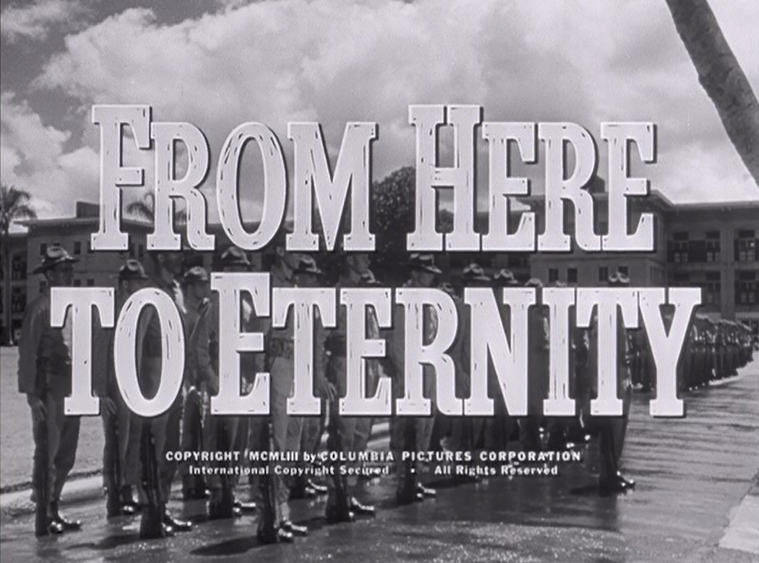
1953: From Here to Eternity
Screenplay by Daniel Taradash
Adapted from the novel From Here to Eternity by James Jones
This is the story of soldiers stationed in Hawaii in 1941. It mostly, although not exclusively, focuses on two in particular: Private Prewitt and First Sergeant Warden. Prewitt, aka Prew, was in the bugle corps until a disagreement caused him to be transferred and demoted. He was also once an accomplished boxer, until he accidentally blinded his friend when they were sparring. His new commanding officer, Captain Holmes, wants Prew on his boxing team, and instructs his noncoms to make his life as difficult as possible until he agrees to join. Warden doesn't think much of Prew, but he also doesn't think much of the way Holmes runs his company, so he does what he can to help Prew out, when he's not too busy falling in love with Mrs. Holmes. And of course, we all know what happened in Hawaii at the end of 1941.
I feel like this was an unnecessarily long book. There were too many characters who were described in too much detail, given how unimportant they were to the story. Also, pretty much all of the characters had very long philosophical internal monologues that could easily have been cut, or at least shortened. I enjoyed the parts when we had glimpses into what each character in a conversation was really thinking, but I could have done without the paragraphs of minor characters pondering, and the pages of major characters pondering, without coming to any conclusions. The story was intriguing, but I didn't need all the philosophy.
That being said, I think that made it relatively straightforward to turn an 800-page novel into a 2-hour movie. Once they cut all the unnecessary philosophy and some of the less important minor characters (not to mention all of the explicit, vulgar, and violent content that was definitely not allowed in the Hollywood of the 1950s), it must not have seemed nearly as daunting. In many cases, minor characters from the novel were combined into one slightly juicier minor character in the film. For instance, Bloom, who ends up killing himself in the book, is not in the film, but some of the things he does are important enough to be taken over by "Fatso" Judson and Ike Galovitch. In other cases, minor characters remained but in a significantly reduced form. Maylon Stark is quite important in the book. He's a cook who joins the company soon after Prew, and Warden finagles him into the head cook position because he's much more competent than their previous head cook. Stark also becomes pretty good friends with Prew, and even introduces him to "Lorene" - a prostitute crucial enough to the plot that they couldn't eliminate her from the movie, although her scenes are so cleaned up that modern audiences might not understand that that's what she's supposed to be. Stark also fights with Warden because he used to date Captain Holmes's wife and she treated him terribly (the details and reasons are significantly different in the book and the movie, I think mostly because of production codes). In the film, his only scene is one in which he briefly warns Warden about her. Most of the rest of his role is either taken over by Prew's friend Maggio or eliminated entirely. It's kind of a shame because book Stark is an interesting character, but I can see why they reduced his role. The one minor character change that I'm really irritated about is the squad leader. In the book, he's a Native American named Corporal Choate; in the film, he's a white man named Corporal Buckley. I mean, I guess it's better that he was changed to a white man than portrayed by a white man in offensive makeup, but only slightly.
Most of the changes that did not involve reducing minor characters, philosophical monologues, or sexual content seem to have been made to show the Army itself in a much better light. In the book, Holmes is promoted and no one really cares what he did to Prew; in the movie, he's dishonorably discharged because of it. The book also has a whole section in which Prew is in the stockade, where all the prisoners are constantly beaten, nearly starved, and otherwise abused. Maggio escapes by pretending to be insane; a different man is beaten to death after complying when another prisoner begs him to break his arm. In the film, Prew never goes to the stockade at all. The film does include someone being beaten to death by "Fatso" Judson, but it's Maggio, and it's implied that this is because of a fight they had earlier, which was actually with Bloom in the book. The film implies that this is an exceptional situation, whereas the book makes it seem more like an everyday occurrence in the stockade.
While this clearly isn't the most faithful of adaptations, it's still a very good adaptation. Everything ties together very well despite many eliminations. When you watch the movie, it doesn't feel like you're missing pieces of the story. Often, I'm annoyed with changes between page and screen, but I think for the most part the right decisions were made in this case. If the book was adapted into a movie today, it would probably be a lot different, and rated NC-17. It was remade into a mini-series in 1979, with the tagline "The whole story. The story Hollywood couldn't tell in 1953!" I imagine that's a much more faithful adaptation of the book, both because of its 6-hour length and because it was made 26 years later. Given the time constraint and the period in which it was made, this film is probably about as faithful of an adaptation as it could have been, and personally given the choice I'd much rather rewatch it than reread the book.
Coming up next: The Country Girl, which I blogged about before because Grace Kelly won Best Actress, based on the play by Clifford Odets
Adapted from the novel From Here to Eternity by James Jones
This is the story of soldiers stationed in Hawaii in 1941. It mostly, although not exclusively, focuses on two in particular: Private Prewitt and First Sergeant Warden. Prewitt, aka Prew, was in the bugle corps until a disagreement caused him to be transferred and demoted. He was also once an accomplished boxer, until he accidentally blinded his friend when they were sparring. His new commanding officer, Captain Holmes, wants Prew on his boxing team, and instructs his noncoms to make his life as difficult as possible until he agrees to join. Warden doesn't think much of Prew, but he also doesn't think much of the way Holmes runs his company, so he does what he can to help Prew out, when he's not too busy falling in love with Mrs. Holmes. And of course, we all know what happened in Hawaii at the end of 1941.
I feel like this was an unnecessarily long book. There were too many characters who were described in too much detail, given how unimportant they were to the story. Also, pretty much all of the characters had very long philosophical internal monologues that could easily have been cut, or at least shortened. I enjoyed the parts when we had glimpses into what each character in a conversation was really thinking, but I could have done without the paragraphs of minor characters pondering, and the pages of major characters pondering, without coming to any conclusions. The story was intriguing, but I didn't need all the philosophy.
That being said, I think that made it relatively straightforward to turn an 800-page novel into a 2-hour movie. Once they cut all the unnecessary philosophy and some of the less important minor characters (not to mention all of the explicit, vulgar, and violent content that was definitely not allowed in the Hollywood of the 1950s), it must not have seemed nearly as daunting. In many cases, minor characters from the novel were combined into one slightly juicier minor character in the film. For instance, Bloom, who ends up killing himself in the book, is not in the film, but some of the things he does are important enough to be taken over by "Fatso" Judson and Ike Galovitch. In other cases, minor characters remained but in a significantly reduced form. Maylon Stark is quite important in the book. He's a cook who joins the company soon after Prew, and Warden finagles him into the head cook position because he's much more competent than their previous head cook. Stark also becomes pretty good friends with Prew, and even introduces him to "Lorene" - a prostitute crucial enough to the plot that they couldn't eliminate her from the movie, although her scenes are so cleaned up that modern audiences might not understand that that's what she's supposed to be. Stark also fights with Warden because he used to date Captain Holmes's wife and she treated him terribly (the details and reasons are significantly different in the book and the movie, I think mostly because of production codes). In the film, his only scene is one in which he briefly warns Warden about her. Most of the rest of his role is either taken over by Prew's friend Maggio or eliminated entirely. It's kind of a shame because book Stark is an interesting character, but I can see why they reduced his role. The one minor character change that I'm really irritated about is the squad leader. In the book, he's a Native American named Corporal Choate; in the film, he's a white man named Corporal Buckley. I mean, I guess it's better that he was changed to a white man than portrayed by a white man in offensive makeup, but only slightly.
Most of the changes that did not involve reducing minor characters, philosophical monologues, or sexual content seem to have been made to show the Army itself in a much better light. In the book, Holmes is promoted and no one really cares what he did to Prew; in the movie, he's dishonorably discharged because of it. The book also has a whole section in which Prew is in the stockade, where all the prisoners are constantly beaten, nearly starved, and otherwise abused. Maggio escapes by pretending to be insane; a different man is beaten to death after complying when another prisoner begs him to break his arm. In the film, Prew never goes to the stockade at all. The film does include someone being beaten to death by "Fatso" Judson, but it's Maggio, and it's implied that this is because of a fight they had earlier, which was actually with Bloom in the book. The film implies that this is an exceptional situation, whereas the book makes it seem more like an everyday occurrence in the stockade.
While this clearly isn't the most faithful of adaptations, it's still a very good adaptation. Everything ties together very well despite many eliminations. When you watch the movie, it doesn't feel like you're missing pieces of the story. Often, I'm annoyed with changes between page and screen, but I think for the most part the right decisions were made in this case. If the book was adapted into a movie today, it would probably be a lot different, and rated NC-17. It was remade into a mini-series in 1979, with the tagline "The whole story. The story Hollywood couldn't tell in 1953!" I imagine that's a much more faithful adaptation of the book, both because of its 6-hour length and because it was made 26 years later. Given the time constraint and the period in which it was made, this film is probably about as faithful of an adaptation as it could have been, and personally given the choice I'd much rather rewatch it than reread the book.
Coming up next: The Country Girl, which I blogged about before because Grace Kelly won Best Actress, based on the play by Clifford Odets
Sunday, September 17, 2017
1952: The Bad and the Beautiful
Screenplay by Charles Schnee
Adapted from the story "Tribute to a Badman", aka "Memorial to a Bad Man", by George Bradshaw
Three people in the entertainment field reflect on why they despise a certain big-time producer. In spite of themselves, they begin to realize that much of their success is due, at least in part, to the horrible things he did to them.
This is definitely one of the less faithful adaptations to win this award. The theme of corruption in the entertainment industry and the question of the ends justifying the means are consistent, but otherwise the short story and the film are completely different. All of the names were changed, of course. The original story deals with Broadway people who came to Hollywood but intend to return to Broadway; the film deals only with Hollywood. In the story, the producer they all hate has died. On his death bed, he gave a letter to a fourth person who doesn't hate him quite as much, pointing out how much he helped them by pushing them away, and asking them to create a new stage show in his honor. In the film, he is not dead, but is no longer successful, and wants to jump-start his career by producing a new film that the people who hate him all work on. This creates some added conflict in the movie because not only are they supposed to comply with his wishes, but they also have to work directly with him again; whereas the short story people only have to face his memory, not the actual man. The way the producer wronged each of them is completely different, and in many ways seems significantly worse in the film, though perhaps that's merely because we actually see it play out in the film. In the story, people are telling abbreviated versions of their stories several years after the fact, which doesn't quite have the same impact as seeing the whole thing unfold on screen.
So despite the fact that in some ways the film seems like a completely different story from the original, I actually feel like this was a pretty good adaptation. It clearly drew inspiration from the short story without feeling confined by it, and the changes worked. The original story is interesting, but it's essentially just four people sitting in a room and talking, which would make for a pretty boring movie, so obviously it needed to be changed and expanded to become an engaging feature film. I think the filmmakers succeeded.
This story was originally published in the February 1951 issue of The Ladies' Home Journal, which I was able to order a copy of online, and I have to say that reading it in its original form was worth it for the old advertisements alone. It was originally published under the title "Memorial to a Bad Man," but I've seen it called "Tribute to a Badman" in other places, though I'm not quite sure why. But this one was much more fun to read than the previous year's winner.
Next up: Best Picture Winner From Here to Eternity, based on the novel by James Jones
Adapted from the story "Tribute to a Badman", aka "Memorial to a Bad Man", by George Bradshaw
Three people in the entertainment field reflect on why they despise a certain big-time producer. In spite of themselves, they begin to realize that much of their success is due, at least in part, to the horrible things he did to them.
This is definitely one of the less faithful adaptations to win this award. The theme of corruption in the entertainment industry and the question of the ends justifying the means are consistent, but otherwise the short story and the film are completely different. All of the names were changed, of course. The original story deals with Broadway people who came to Hollywood but intend to return to Broadway; the film deals only with Hollywood. In the story, the producer they all hate has died. On his death bed, he gave a letter to a fourth person who doesn't hate him quite as much, pointing out how much he helped them by pushing them away, and asking them to create a new stage show in his honor. In the film, he is not dead, but is no longer successful, and wants to jump-start his career by producing a new film that the people who hate him all work on. This creates some added conflict in the movie because not only are they supposed to comply with his wishes, but they also have to work directly with him again; whereas the short story people only have to face his memory, not the actual man. The way the producer wronged each of them is completely different, and in many ways seems significantly worse in the film, though perhaps that's merely because we actually see it play out in the film. In the story, people are telling abbreviated versions of their stories several years after the fact, which doesn't quite have the same impact as seeing the whole thing unfold on screen.
So despite the fact that in some ways the film seems like a completely different story from the original, I actually feel like this was a pretty good adaptation. It clearly drew inspiration from the short story without feeling confined by it, and the changes worked. The original story is interesting, but it's essentially just four people sitting in a room and talking, which would make for a pretty boring movie, so obviously it needed to be changed and expanded to become an engaging feature film. I think the filmmakers succeeded.
This story was originally published in the February 1951 issue of The Ladies' Home Journal, which I was able to order a copy of online, and I have to say that reading it in its original form was worth it for the old advertisements alone. It was originally published under the title "Memorial to a Bad Man," but I've seen it called "Tribute to a Badman" in other places, though I'm not quite sure why. But this one was much more fun to read than the previous year's winner.
Next up: Best Picture Winner From Here to Eternity, based on the novel by James Jones
Saturday, September 16, 2017
1951: A Place in the Sun
Screenplay by Harry Brown and Michael Wilson
Adapted from the novel An American Tragedy by Theodore Dreiser and the play An American Tragedy by Patrick Kearney
A young man with a poor background moves to a new town to work in his rich uncle's factory. Ignored by his relatives who refuse to associate with him socially, he becomes lonely, which leads to a romantic involvement with another lower-class factory worker. When the high society people, including one beautiful woman in particular, start to pay attention to him, he starts neglecting his first girlfriend, preparing to eventually break up with her. Unfortunately, things don't quite work out.
Full disclosure: I did not read the play, so I can only compare the novel and the film. I'm a little curious as to how the play compares, but I'm so sick of this story that I couldn't bring myself to read it. Maybe someday. I think this is my second least favorite book I've read for this project so far (the interminable Emile Zola biography is still the low point). It's not necessarily a bad book; I just didn't like it. Honestly, I think I liked the movie better, although it still isn't my favorite.
In addition to changing the title, the film also gives all the main characters different names. Clyde Griffiths becomes George Eastman, and his rich uncle goes from owning a shirt collar factory to a bathing suit factory. The poor factory girl changes from Roberta Alden to Alice Tripp, and the high society girl changes from Sondra Finchley to Angela Vickers. I've noticed several adaptations so far in which the names where changed, and I still don't really understand why filmmakers do that. It seems to occur more in adaptations that are less faithful overall, so maybe the names are changed to warn devotees of the original stories not to expect the films to follow them too closely? I don't know. Regardless, this film departs significantly from the novel, but as far as I could tell most of the changes served one or more of the following purposes: to reduce the length, to make the protagonist more sympathetic, and/or to give Elizabeth Taylor a bigger role.
The novel is 856 pages and the film is just over 2 hours, so obviously things had to be cut. The entire first section of the book, when Clyde is a youth in Kansas City, is completely eliminated from the film. George mentions some of his background, which is fairly consistent with Clyde's background except that George's father is dead, and there's no mention of the terrible accident that caused Clyde, if not George, to leave Kansas City in the first place. The movie also cuts a lot of the filler parts of the book, which makes sense, but also makes it seem like everything happens much faster than it did in the book. There are a few lines that indicate that time has passed, but it's hard to tell how much. Overall, the cutting for time works, but it does eliminate a lot of the foreshadowing that the novel employs, which is unfortunate because the foreshadowing was one of the few things I liked about the book.
I don't want to spoil too much in case anyone's planning on reading or watching this at some point (again, it's not bad, I just didn't enjoy it), but I will say that Clyde/George gets accused of a serious crime. The thing about it is he was planning on committing this crime, and then changes his mind at the last second, but then it happens by accident anyway. This is true in both versions, but he is much more sympathetic in the movie. Clyde spends a lot more time planning it out and covering his tracks afterwards, and then, at the advice of his lawyers, lies at the trial to say he never planned it in the first place. George, however, barely has time to plan much of anything, and tells the truth at the trial. Also, Clyde seemed to have more of a way out without committing this crime than George did. The reader is clearly supposed to sympathize with Clyde, and in a way I kind of did by the end, but mostly I was like, "It's your own fault, you jerk." I felt a little bit like that toward George as well, but definitely less so, which I think is part of the reason I liked the movie better.
Finally, there's the character of the high society girl. She's not actually in very much of the book, so when I heard that Elizabeth Taylor was playing her I was a bit confused, since I don't generally think of her playing such small roles. So I was not incredibly surprised that her character was significantly more important in the film. Angela and George's romance is much more developed and committed than Clyde and Sondra's, which again makes George more sympathetic than Clyde. Sondra pretty much disappears from the book after Clyde is arrested, whereas we see some of Angela's reactions to the trial. Not that Sondra isn't sympathetic, since it's clear that none of what happens is her fault, but one can't help liking Angela more.
I don't mean to imply that the film completely whitewashes the story. It still touches on many of the dark issues portrayed in the book, if significantly less explicitly (not surprising for 1951 Hollywood). But I'm kind of curious how I would have reacted to the film if I'd watched it without having read the book. I couldn't feel too bad for George because I hated Clyde so much, but maybe if I hadn't known how he acted in the book, I might have liked him in the film. Who knows? Mostly I'm just very glad to be through this so I can move forward with this project.
Fortunately, the next winner was based on a short story, so I'll have a brief respite before the next long novel. So stay tuned for The Bad and the Beautiful, based on the story "Tribute to a Badman" by George Bradshaw.
Adapted from the novel An American Tragedy by Theodore Dreiser and the play An American Tragedy by Patrick Kearney
A young man with a poor background moves to a new town to work in his rich uncle's factory. Ignored by his relatives who refuse to associate with him socially, he becomes lonely, which leads to a romantic involvement with another lower-class factory worker. When the high society people, including one beautiful woman in particular, start to pay attention to him, he starts neglecting his first girlfriend, preparing to eventually break up with her. Unfortunately, things don't quite work out.
Full disclosure: I did not read the play, so I can only compare the novel and the film. I'm a little curious as to how the play compares, but I'm so sick of this story that I couldn't bring myself to read it. Maybe someday. I think this is my second least favorite book I've read for this project so far (the interminable Emile Zola biography is still the low point). It's not necessarily a bad book; I just didn't like it. Honestly, I think I liked the movie better, although it still isn't my favorite.
In addition to changing the title, the film also gives all the main characters different names. Clyde Griffiths becomes George Eastman, and his rich uncle goes from owning a shirt collar factory to a bathing suit factory. The poor factory girl changes from Roberta Alden to Alice Tripp, and the high society girl changes from Sondra Finchley to Angela Vickers. I've noticed several adaptations so far in which the names where changed, and I still don't really understand why filmmakers do that. It seems to occur more in adaptations that are less faithful overall, so maybe the names are changed to warn devotees of the original stories not to expect the films to follow them too closely? I don't know. Regardless, this film departs significantly from the novel, but as far as I could tell most of the changes served one or more of the following purposes: to reduce the length, to make the protagonist more sympathetic, and/or to give Elizabeth Taylor a bigger role.
The novel is 856 pages and the film is just over 2 hours, so obviously things had to be cut. The entire first section of the book, when Clyde is a youth in Kansas City, is completely eliminated from the film. George mentions some of his background, which is fairly consistent with Clyde's background except that George's father is dead, and there's no mention of the terrible accident that caused Clyde, if not George, to leave Kansas City in the first place. The movie also cuts a lot of the filler parts of the book, which makes sense, but also makes it seem like everything happens much faster than it did in the book. There are a few lines that indicate that time has passed, but it's hard to tell how much. Overall, the cutting for time works, but it does eliminate a lot of the foreshadowing that the novel employs, which is unfortunate because the foreshadowing was one of the few things I liked about the book.
I don't want to spoil too much in case anyone's planning on reading or watching this at some point (again, it's not bad, I just didn't enjoy it), but I will say that Clyde/George gets accused of a serious crime. The thing about it is he was planning on committing this crime, and then changes his mind at the last second, but then it happens by accident anyway. This is true in both versions, but he is much more sympathetic in the movie. Clyde spends a lot more time planning it out and covering his tracks afterwards, and then, at the advice of his lawyers, lies at the trial to say he never planned it in the first place. George, however, barely has time to plan much of anything, and tells the truth at the trial. Also, Clyde seemed to have more of a way out without committing this crime than George did. The reader is clearly supposed to sympathize with Clyde, and in a way I kind of did by the end, but mostly I was like, "It's your own fault, you jerk." I felt a little bit like that toward George as well, but definitely less so, which I think is part of the reason I liked the movie better.
Finally, there's the character of the high society girl. She's not actually in very much of the book, so when I heard that Elizabeth Taylor was playing her I was a bit confused, since I don't generally think of her playing such small roles. So I was not incredibly surprised that her character was significantly more important in the film. Angela and George's romance is much more developed and committed than Clyde and Sondra's, which again makes George more sympathetic than Clyde. Sondra pretty much disappears from the book after Clyde is arrested, whereas we see some of Angela's reactions to the trial. Not that Sondra isn't sympathetic, since it's clear that none of what happens is her fault, but one can't help liking Angela more.
I don't mean to imply that the film completely whitewashes the story. It still touches on many of the dark issues portrayed in the book, if significantly less explicitly (not surprising for 1951 Hollywood). But I'm kind of curious how I would have reacted to the film if I'd watched it without having read the book. I couldn't feel too bad for George because I hated Clyde so much, but maybe if I hadn't known how he acted in the book, I might have liked him in the film. Who knows? Mostly I'm just very glad to be through this so I can move forward with this project.
Fortunately, the next winner was based on a short story, so I'll have a brief respite before the next long novel. So stay tuned for The Bad and the Beautiful, based on the story "Tribute to a Badman" by George Bradshaw.
Subscribe to:
Posts (Atom)